
Your needs, this model
Does it fit your priorities?
Does the WF-SP800N clear a nine-hour ANC music minimum?
Sony's model-specific table gives separate Classic Audio SBC and AAC plans, each rated up to nine hours of music with noise cancellation on and thirteen hours with it off. This assessment compares the nine-hour maxima only; it does not claim a battery measurement or guarantee that a used unit still reaches that figure. EQ, environment, host and settings can change playback time.
Explore this need in the finder →What can this model handle around sweat and rain?
Sony identifies IP55 for the headset only, while its model guide separates IPX5 water and IP5X dust tests, says the case is not water/dust resistant, and excludes pool water and immersion. It does not match the finder's narrower IPX4 earbuds-only label or its IP57 buds-and-case choice. Wipe the headset dry and keep moisture away from the case and charging contacts; do not use it underwater.
Explore this need in the finder →Can I switch between a computer and phone without disconnecting?
No. Sony explicitly says the WF-SP800N does not support a multipoint connection. It supports one documented Bluetooth source at a time in the reviewed SBC/AAC plans, so a laptop-and-phone routine may require manually changing the connection. Pairing memory or touch controls would not establish two simultaneous links.
Explore this need in the finder →Is the reviewed case wireless-chargeable?
No. Sony's support representative identifies the WF-SP800N case as unable to charge wirelessly, and the Sony guide specifies its supplied USB Type-C cable for case charging. This exact Black U.S. retailer configuration therefore meets the finder's USB-C-and-no-wireless case condition; a used offer still needs the correct case and cable.
Explore this need in the finder →The Sony WF-SP800N is an earlier true-wireless sports model with a sealed in-ear fit, active noise cancellation, arc supporters and a headset-only IP55 rating. Its documented Classic Audio plans reach up to nine hours of music per charge with ANC on, whether the connection uses SBC or AAC. This assessment is based on Sony's U.S. launch, specification and model-guide material plus an exact U.S. retailer identity; it is not a hands-on test, sound measurement or personal fit report.
A sports-oriented fit you still have to try
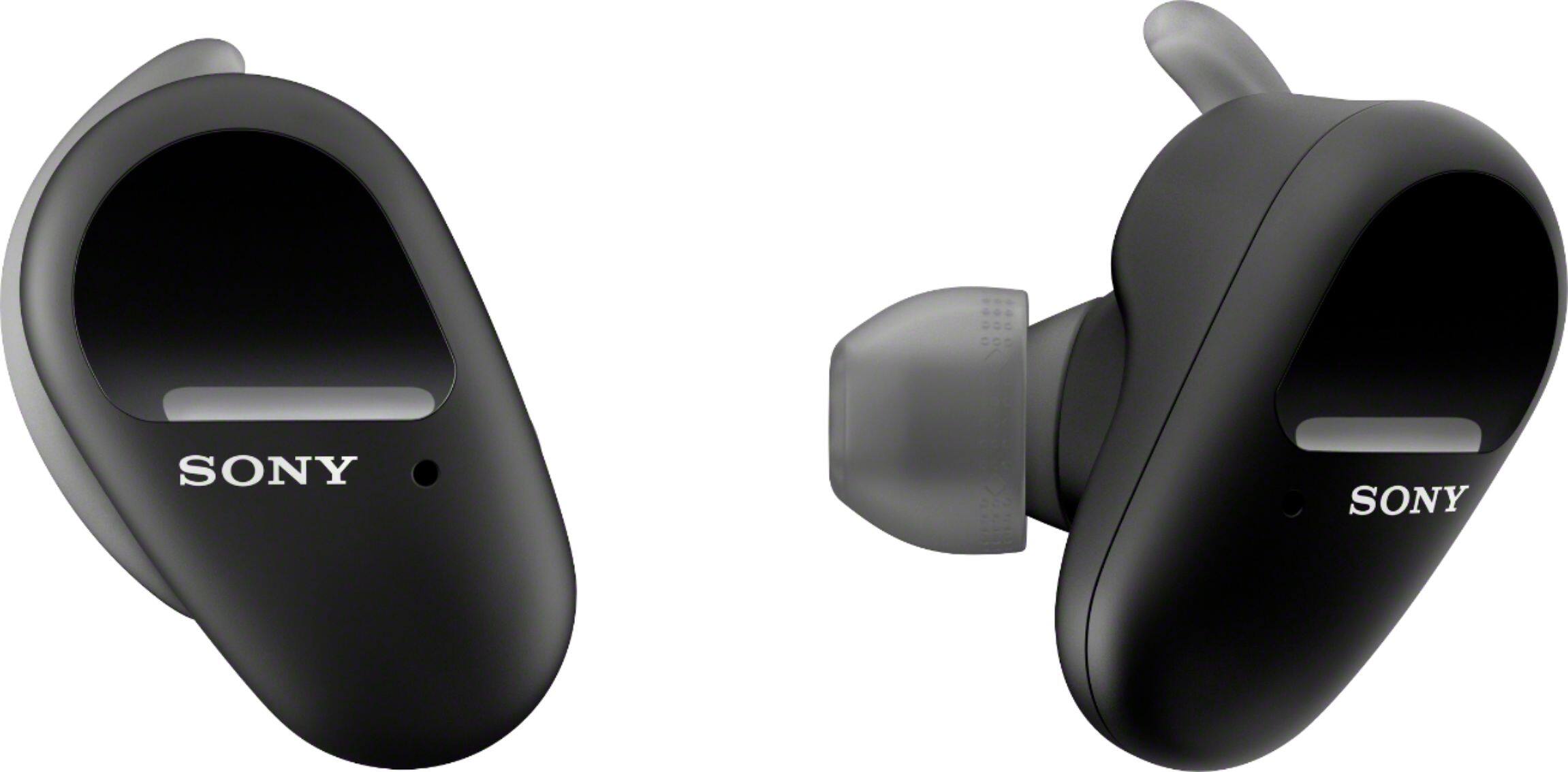
Sony calls the WF-SP800N closed and dynamic. Each earbud takes a silicone tip and a separate arc supporter; the original package list has five tip sizes (SS through LL) and two supporter sizes (M and L), with M parts attached from the start. Sony's guide shows a twist-in motion intended to seat the supporter in the ear groove, and it notes that choosing tip size affects both seal and noise-canceling operation. Those details make the fitting method more adjustable than a tip-only description suggests, but they do not prove the earbud will feel secure or comfortable in your ear. Different people—and sometimes left and right ears—need different sizes.
Sony pitched it for exercise, but the arc supporter cannot guarantee personal retention or comfort. The Black U.S. listing is WFSP800N/B, item 6408358. The original-parts list does not prove a resale package includes every tip, supporter, cable or working case.
ANC, ambient sound and host-device switching
Active noise cancellation and Ambient Sound Mode are documented controls: Sony says the units use built-in microphones and the left touch control cycles among cancellation, ambient listening and neither. Neither mode is a substitute for a personal fit check, and the manual says noise reduction is not complete and may vary with how the earbuds are worn. I have no measured attenuation or call-quality result to report. Sony also warns that ambient sound may be hard to hear under some conditions; do not rely on it as a safety system near traffic.
The guide lists SBC and AAC as the two supported music codecs over Bluetooth Classic Audio. These are source-device compatibility choices, not a promise of a sound-quality ranking. The manufacturer rates ANC-on music at the same maximum nine hours for each. Sony explicitly says that the WF-SP800N does not support Bluetooth multipoint. Someone moving between a laptop and phone should expect to manage the connection rather than assume both can remain linked at once.
Nine hours per charge is a maximum, not used-battery evidence
Sony's model-specific operating-time table gives up to nine hours for music with ANC on, and up to thirteen with ANC off, separately for both SBC and AAC. The case can provide one additional full charge, for Sony's launch-announcement totals of up to 18 hours with ANC on and 26 hours off. A quick-charge claim says ten minutes can supply about 60 minutes of music. The table is a manufacturer maximum under its stated setup; volume, environment, software settings, codec negotiation and battery age can all change real playback time. This review did not measure a sample.
That caveat is central for an earlier model. A 2020 launch date and a currently available support manual tell you what the design was, not how much capacity remains in a particular pair. If considering a used or refurbished unit, ask for the exact case, confirm both earbuds charge and connect, and check the seller's return window. An advertised original maximum is not evidence that an older battery will reproduce it.
IP55 applies to the headset, not the case
Sony's U.S. specifications label the headset IP55. The detailed manual describes its headset water performance as IPX5 and dust performance as IP5X; the charging case is not water- or dust-resistant. Sony limits the stated water conditions to fresh water, tap water and perspiration, excludes pool water and seawater, says the sound outlets are not completely watertight, and warns not to drop or use the headset underwater. After a sweaty session, follow the model's wipe-and-dry instructions and keep the contacts dry before placing the buds in the case.
That is a materially different claim from either of this site's exact water finder choices: the WF-SP800N is not rated IPX4, and its case is not IP57. It therefore does not match those particular questionnaire options, even though its U.S. headline rating is numerically higher than IPX4. Do not flatten distinct IP tests, component boundaries or liquid restrictions into a vague “waterproof” label.
USB-C case, without wireless charging
Sony's charging guide specifies the supplied short USB-A-to-USB-C cable and gives approximate full-charge times of 2.5 hours for the earbuds and three hours for the headset plus case. In a product Q&A for the exact model, Sony's support representative says its case cannot charge on a wireless pad. Together, that evidence supports the finder's strict USB-C wired-only case condition. It does not make the charging case resistant to rain or sweat. Verify the case marking, cable, contacts and charging behavior in any earlier package.
Who should consider this earlier Sony?
On paper, the SP800N is most distinctive for a buyer who values an adjustable sealed sports fit, a documented headset-only IP55 rating, active cancellation and a nine-hour maximum in either SBC or AAC. The trade-offs are equally concrete: no multipoint, no wireless case charging, a large 2.08-ounce case, and no exact IPX4/IP57 match in this finder. Its older-generation status and the Best Buy page's “no longer available in new condition” note mean this is a reference for evaluating an existing or resale offer, not a statement that new stock is available. Check battery condition, fit, full accessory set, seller warranty and returns before deciding. There is no test or personal-use verdict here.
Sources: Sony Electronics U.S. launch announcement; Sony USA specifications; Sony WF-SP800N Help Guide; Sony runtime table; Best Buy exact Black configuration; SonyListens charging-case answer.
Key specifications
Key details at a glance
| Wearing style | Sealed in-ear |
|---|---|
| Active noise cancellation | Yes |
| Wireless charging case | No |
| Water protection | Ip55 headset only |
| Bluetooth version | 5 |
| Supported codecs (mode matters) | sbc / aac |
| Two-device Bluetooth multipoint | No |
| Weight per earbud | 0.35 oz |
| Charging-case weight | 2.08 oz |
| Maximum ANC music time: SBC | 9 hours |
| Maximum ANC music time: AAC | 9 hours |
| Maximum SBC music time | 13 hours |
| Maximum AAC music time | 13 hours |
Use the exact model’s instructions for operating limits, supplied equipment and version differences.
Sources for this review
Sources for this assessment
- Say Yes to Music and No to Sweat with Sony's New Truly Wireless WF-SP800N Sport Headphones | Sony Electronics Inc.
- Support for WF-SP800N | Sony USA
- WF-SP800N Specifications | Sony USA
- WF-SP800N Help Guide | Sony
- Available operating time | WF-SP800N Help Guide
- Wearing the headset | WF-SP800N Help Guide
- Checking the package contents | WF-SP800N Help Guide
- Charging | WF-SP800N Help Guide
- On water resistant/dust proofing performance | WF-SP800N Help Guide
- Precautions | WF-SP800N Help Guide
- SonyListens answer on charging | Best Buy WF-SP800N product Q&A
- Sony WF-SP800N True Wireless Noise-Cancelling In-Ear Headphones - Black | Best Buy
Compare the documented details with your routine
Use the finder to combine only requirements supported by one documented operating arrangement. It cannot guarantee comfort or compatibility with every host.