
Your needs, this model
Does it fit your priorities?
Does the WF-C500 suit an earlier sealed, no-ANC shortlist?
Sony documents the WF-C500 as a closed, tip-equipped true-wireless earbud and its current Sony Electronics comparison says the older WF-C500 has no ANC. Those facts fit a sealed, no-ANC shopping requirement, but the manual warns that fit and call performance depend on how the tips seat. No personal fit or comfort test was performed; check exact seller condition and return terms.
Explore this need in the finder →Which source codec and device-switching plan is documented?
Sony lists SBC and AAC for Classic Audio; the model guide does not document LDAC or LC3. It explicitly says the WF-C500 does not support multipoint, so multiple saved pairings do not mean two simultaneous Bluetooth source connections. Confirm the playback device can use the codec you want.
Explore this need in the finder →What do its rating and charging instructions actually cover?
Sony's U.S. specification and official product video identify an IPX4 rating for the earbuds; Sony's video specifically warns that the charging case is not water resistant. The help guide specifies case charging by the supplied USB Type-C cable. It does not establish wireless charging, so the case does not satisfy either of the finder's essential charging-method options from this record.
Explore this need in the finder →What should a buyer inspect on an older offer?
The original Sony package list names the case, USB-C cable and three tip sizes (SS, M and LL); it is not proof that a used listing still includes them. Sony also says the earbud units and charging case cannot be bought separately for WF-C500. Check the exact model, both earbuds, charging case, cable, tips, battery behavior and the seller's return terms before treating an old offer as complete.
Explore this need in the finder →The Sony WF-C500 is a small, earlier true-wireless model whose documented case connection is USB-C and whose supported Classic Audio formats are SBC and AAC. It is a no-ANC design, so it belongs on a very different shortlist from Sony’s current noise-canceling WF-C710N or the ANC-equipped WF-C700N. This is a source-based assessment of the model record, not a hands-on listening or fit test.
Sealed tips, but no active noise cancellation
Sony’s U.S. specification calls the WF-C500 “closed, dynamic,” and the model guide shows a tip seated in the ear canal. The supplied set includes SS, M and LL hybrid silicone tips, with M attached at first. Sony’s fit instructions say to twist the earbud so the tip sits in the canal and to try other sizes when the seal or call performance is not right. That is useful setup guidance, not a promise that its shape will fit your ear. Tip fit can vary between left and right ears, and Sony’s precautions warn that a tight seal can make quick removal uncomfortable.
The important distinction is that a sealed passive fit is not active noise cancellation. Sony’s current U.S. editorial identifies the older WF-C500 as having no ANC. If your non-negotiable is ANC for a commute or airplane, the C500 does not meet it; if you prefer a sealed tip without ANC electronics, it is a documented no-ANC option. The ear-tip seal may change how much surrounding sound reaches you, but there is no independent isolation or sound measurement in this assessment. Follow your environment’s safety needs rather than treating passive seal as an awareness mode.
Connection: two supported codecs, one source at a time
The checked Sony specification lists Bluetooth 5.0 and SBC/AAC audio. Those are Classic Audio routes; the model-specific manual does not establish LDAC or LC3. The host device chooses what it can negotiate, and the codec label is not a guarantee of a better result on every phone, app or recording. Sony’s Headphones Connect app can expose the connection codec and offers equalizer and DSEE settings, but those features do not add a new Bluetooth codec.
Device switching is a more consequential limitation for desk-and-phone routines: Sony explicitly says that the WF-C500 does not support multipoint. Its pairing guide allows stored pairings with multiple devices, yet playback comes from one paired source at a time. That is not the same as two live connections; expect to disconnect or change the host before moving audio. Choose another model if uninterrupted laptop-and-phone multipoint is essential.
Battery figures are manufacturer maxima, not a promise for an old unit
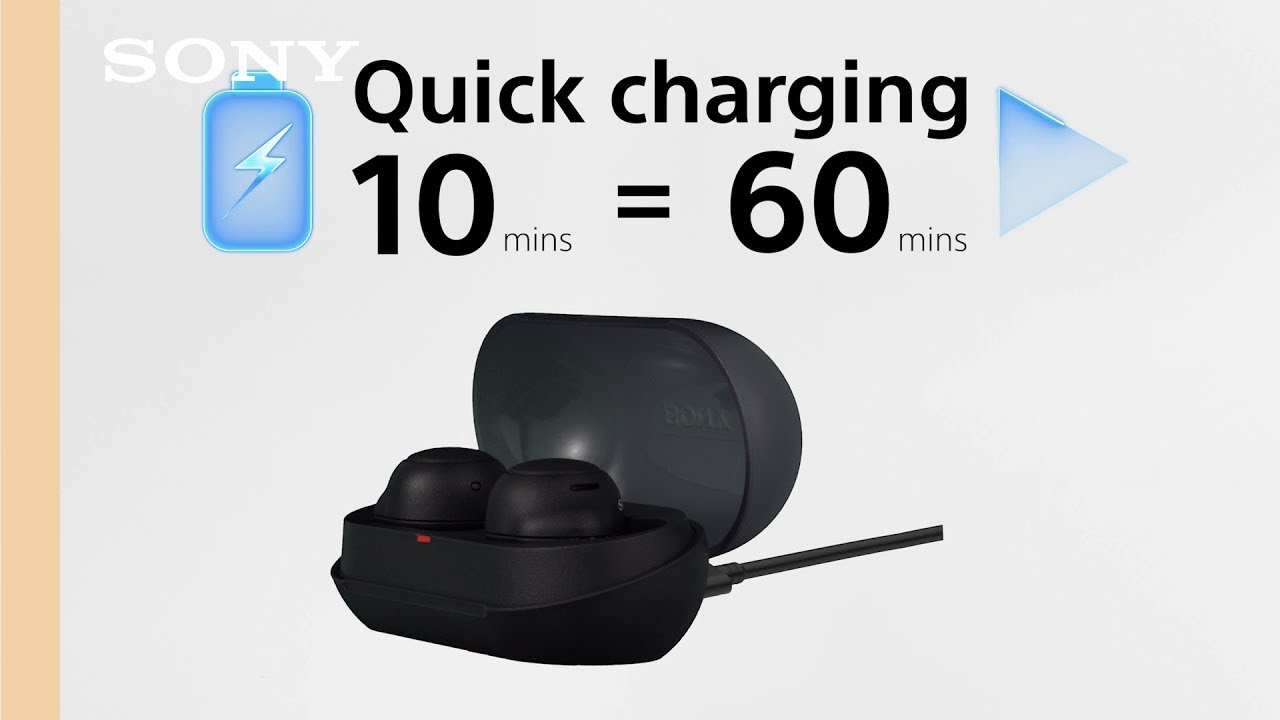
Sony lists up to ten hours of continuous music for a fully charged earbud pair. The detailed manual table gives the same maximum for SBC and AAC with DSEE set to Auto or off, then warns that equalizer and DSEE use reduce the available time. Sony’s product-feature material describes up to twenty hours including one case recharge. These are initial-condition maximum claims, not measurements made here. Sony also gives about three hours to charge the case and earbuds fully, and says a ten-minute charge can provide about an hour of playback.
For an earlier product, the published figure is only a planning reference. Lithium-ion capacity declines with age, storage and use; the current charge behavior of an individual listing is unknown. A seller should be able to clarify whether both earbuds connect, whether the case charges them, and whether returns are allowed if one side drains unusually fast. This review has no battery sample or ownership history to compare against.
Case, moisture and package checks
The model guide specifies the supplied USB-A-to-USB-C cable for charging. USB-C is documented; wireless charging is not established in the official material checked here, so I do not mark this version as either “USB-C and no wireless” or “wireless required” in the finder. The distinction matters because a buyer should not infer a case’s full charging capability from its cable port alone.
Sony lists IPX4 for the earbuds, and its official feature video says the charging case is not water resistant. Keep that rating attached to the buds only: it is not a waterproof claim and does not cover the case, immersion, a shower or swimming. Allow wet earbuds to dry and keep liquid away from the charging contacts before storage or charging.
The original package list names the left and right earbuds, the case, one short USB-C cable and SS/M/LL tip pairs. That historic list cannot prove the contents of a used offer. Sony also states that the WF-C500 earbud units and case are not available as separately replaceable parts. Inspect both buds, the correct case, cable, tip set, charging response, exact model marking and the seller’s return terms. Do not assume WF-C510 parts or a newer Sony case are interchangeable.
Who should keep it on the list?
The WF-C500 is a plausible research match for someone looking for an earlier, sealed, non-ANC earbud with SBC/AAC and a USB-C charging path. Its biggest functional exclusions are just as clear: no active cancellation and no simultaneous multipoint. The case’s wireless charging status remains undocumented here, so it cannot be used to satisfy either exact case-charging requirement. Sony’s current material labels it an older model; it does not establish current stock or the health of any third-party unit. Start from the earlier, sealed, no-ANC finder results only if you are prepared to inspect the exact offer. A secondhand listing is not equivalent to a newly supported package, and no price, stock, seller quality or customer experience is asserted.
Sources: Sony USA specifications; Sony WF-C500 Help Guide; Sony Electronics U.S. budget-earbud guidance; Sony USA replacement-parts guidance.
Key specifications
Key details at a glance
| Wearing style | Sealed in-ear |
|---|---|
| Active noise cancellation | No |
| Water protection | IPX4 earbuds; case not water resistant |
| Bluetooth version | 5 |
| Supported codecs (mode matters) | sbc / aac |
| Two-device Bluetooth multipoint | No |
| Weight per earbud | 0.2 oz |
| Charging-case weight | 1.24 oz |
| Maximum SBC music time | 10 hours |
| Maximum AAC music time | 10 hours |
| Manufacturer total with case | 20 hours |
| Published noise-control-off runtime per charge | 10 hours |
Use the exact model’s instructions for operating limits, supplied equipment and version differences.
Sources for this review
Sources for this assessment
- Support for WF-C500 | Sony USA
- WF-C500 Specifications | Sony USA
- How to pair Bluetooth headphones with a Bluetooth source device | Sony USA
- WF-C500 Help Guide | Sony
- Available operating time | WF-C500 Help Guide
- Wearing the headset | WF-C500 Help Guide
- Checking the package contents | WF-C500 Help Guide
- Charging | WF-C500 Help Guide
- Precautions | WF-C500 Help Guide
- Pairing and connecting with a Bluetooth device | WF-C500 Help Guide
- WF-C500 Truly Wireless In-ear Headphones Product Features | Sony Electronics
- Any budget earbuds that punch above their weight? | Sony Electronics
- Replacing lost or damaged earbuds and charging cases | Sony USA
Compare the documented details with your routine
Use the finder to combine only requirements supported by one documented operating arrangement. It cannot guarantee comfort or compatibility with every host.