
Your needs, this model
Does it fit your priorities?
Does the Black WF-1000XM3 meet a sealed ANC need?
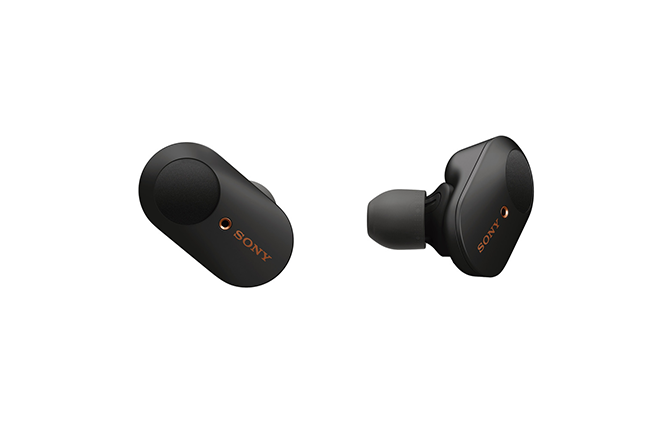
Sony documents the WF-1000XM3 as a noise-canceling wireless headset and its model-specific fit instructions use interchangeable canal tips. The Help Guide says fit affects the noise-canceling result and that snug tips can cause discomfort; neither the image nor the included sizes proves a personal seal. This is an earlier US model, and any actual offer needs its own condition and package check.
Explore this need in the finder →Which codec plan reaches five ANC hours?
Sony's operating-time table lists up to 5.5 ANC-on music hours for SBC and six for AAC only with DSEE HX off. With DSEE HX Auto, the corresponding maximum is three hours for either codec. These are Sony maxima for separate settings, not measured results here; the host still must use the intended codec.
Explore this need in the finder →Can it stay connected to two source devices at once?
No. Sony's model-specific Precautions page explicitly says the WF-1000XM3 does not support multipoint. Pairing it with more than one device for switching is not the same as two simultaneous Bluetooth connections, so this assessment does not treat the model as meeting the finder's two-device requirement.
Explore this need in the finder →What are the water and charging boundaries?
Sony's Help Guide says the headset is not waterproof and warns about rain, moisture and sweat; its US specifications do not assign an IP rating. The model's charging instructions specify the supplied USB Type-C cable and charging case, and the US specifications list USB charging rather than a Qi method. Do not transfer water protection to the case or assume wireless charging.
Explore this need in the finder →The WF-1000XM3 is an earlier Sony noise-canceling true-wireless model first announced for the U.S. in 2019. Sony's current product route for this model now redirects to a not-found page; that is why this is an earlier-model assessment, not a claim that a new or used offer is presently available. The Sony USA support page and the model-specific Help Guide establish the product family, but do not identify a particular resale package, seller or battery condition. This is a source-based review, not a hands-on listening, fit or runtime test.
Tip fit is part of the noise-control design
Sony's WF-1000XM3 manual describes placing a tip in the ear canal and twisting the headset into position. The original package list includes long hybrid silicone-rubber tips in SS, S, M and L, plus S, M and L triple-comfort tips; two of each listed size are supplied, with the medium long-hybrid tips fitted at the factory. The variety is useful to consider if one ear needs a different size from the other, but it does not establish a comfortable or secure fit for an individual. Sony specifically says snug-fitting tips can strain the ears and that the materials can deteriorate with age or storage. A used listing should be checked for clean, intact tips and for which sets are actually present.
The model has active noise cancellation and an Ambient Sound Mode, but neither feature guarantees a particular quiet level. Sony's fit guide says to choose tips that let in the least ambient sound and to wear the headset correctly for the noise-canceling function to work as intended. That makes fit a practical first check, not a performance score. Sony also warns that the unit is not waterproof and should be kept away from rain, sweat and moisture. Its U.S. specification page gives no IP rating, so this should not be treated as a rated workout or wet-weather model.
Read the per-codec battery table, not just the case total
The U.S. specification page gives a headline maximum of six hours of continuous music with noise cancellation on and eight hours with it off. Sony's Help Guide makes the settings behind those maxima clearer. With DSEE HX set to off, its ANC-on music maximum is 5.5 hours over SBC and six over AAC. With DSEE HX set to Auto, either codec's ANC-on maximum is three hours. The values are Sony's published limits for specific modes, not independent measurements or a promise of what an aged battery will deliver.
This changes the useful boundary for a five- or six-hour session. A five-hour SBC minimum is within Sony's 5.5-hour DSEE-HX-off claim; a six-hour SBC minimum is not. The AAC plan reaches six hours only with DSEE HX off. With the Auto setting, neither listed codec reaches five hours while ANC is on. Equalizer use can also reduce the time substantially: the guide says it may shorten playback by as much as 45%. A planning requirement should therefore name the codec and processing setting instead of borrowing the longest number from another mode.
Sony's 2019 launch release described up to 24 total noise-canceling hours as six hours per charge plus up to three extra charges from the case. That is a case-supported total over multiple listening periods, not a single uninterrupted six-hour-plus session from the earbuds. The model-specific Help Guide says the full case can recharge the headset about three times. For a present-day earlier unit, battery age and storage history matter more than the original new-product maximum, and neither is established by the old launch claim.
Classic Audio is limited to the documented codecs
Sony's Help Guide lists SBC and AAC for music over A2DP, and the U.S. specifications list Bluetooth 5.0. The checked model materials do not document LDAC or LC3 for the WF-1000XM3, so newer Sony codec lists should not be transferred to it. The phone or computer must still support and select the codec you intend to use; a Bluetooth-version number alone does not establish the negotiated audio route.
This model also does not meet a two-simultaneous-device requirement. Unlike Sony documentation for some later products, the WF-1000XM3 Precautions page explicitly says that it does not support a multipoint connection. Pairing records can be stored or devices can be paired in turn, but that is not the same as maintaining two Bluetooth connections at once. If automatic switching between a phone and computer is essential, this is a meaningful generation difference rather than a setting to assume will appear in the app.
USB charging and water caution belong to different checks
The original package list names a short USB-A-to-USB-C cable; the charging guide explains that the supplied USB Type-C cable charges the case, which then recharges the earbuds. Sony's U.S. specifications list USB charging with the case, not a wireless charging method. A required USB-C cable connection is therefore a practical drawback if the goal is a Qi charging pad, and the actual used package should be checked for the cable and working case. No particular wall adapter is listed as included; Sony says to use a commercially available USB adapter or a computer USB port.
Do not infer any water rating from the ANC or fit descriptions. Sony's guide says the headset is not waterproof, while the U.S. specifications show no IP rating. The checked sources likewise do not assign water resistance to the charging case. Keep both units dry, wipe moisture from the contacts and use the exact model instructions; a case or an apparently intact exterior does not create a rating.
Who should consider this earlier model?
The WF-1000XM3 belongs in an earlier-model comparison when the buyer is willing to verify a specific unit, tip set, case and return policy, and when SBC/AAC with the published DSEE HX settings are sufficient. Its most useful documented distinctions are the four ANC-runtime plans, several original tip sizes, USB-C case charging, no water-resistance rating and Sony's explicit no-multipoint warning. It is not the right documentary match for a requirement of LDAC, LC3, two simultaneous Bluetooth source connections, an IP rating or Qi case charging.
Before considering an actual offer, confirm the exact WF-1000XM3 family, both earbuds, matching case, cable, tip condition, battery behavior, seller identity and return or warranty terms. Sony's present U.S. product route does not establish an orderable offer, and this review does not infer current stock, price, an ASIN or support for any particular resale listing. The assessment makes no ownership, listening, cancellation, call-quality or personal-fit claim.
Primary references: Sony Electronics Inc.'s 2019 U.S. launch announcement; Sony USA's WF-1000XM3 specifications and model support page; and Sony's model-specific operating-time table, supported-codec page, precautions, package list, fit instructions and charging guide.
Key specifications
Key details at a glance
| Wearing style | Sealed in-ear |
|---|---|
| Active noise cancellation | Yes |
| Wireless charging case | No |
| Bluetooth version | 5 |
| Supported codecs (mode matters) | sbc / aac |
| Two-device Bluetooth multipoint | No |
| Weight per earbud | 0.3 oz |
| Charging-case weight | 2.8 oz |
| Maximum ANC music time: SBC | 5.5 hours |
| Maximum ANC music time: AAC | 6 hours |
| Maximum SBC music time | 7.5 hours |
| Maximum AAC music time | 8 hours |
Use the exact model’s instructions for operating limits, supplied equipment and version differences.
Sources for this review
Sources for this assessment
- Support for WF-1000XM3 | Sony USA
- Sony Electronics US launch announcement for WF-1000XM3
- Sony Electronics US WF-1000XM3 product route
- WF-1000XM3 Specifications | Sony USA
- WF-1000XM3 Help Guide | Sony
- Available operating time | WF-1000XM3 Help Guide
- Supported codecs | WF-1000XM3 Help Guide
- Precautions | WF-1000XM3 Help Guide
- Checking the package contents | WF-1000XM3 Help Guide
- Wearing the headset | WF-1000XM3 Help Guide
- Charging the headset | WF-1000XM3 Help Guide
- WF-1000XM3 model image | Sony Help Guide
Compare the documented details with your routine
Use the finder to combine only requirements supported by one documented operating arrangement. It cannot guarantee comfort or compatibility with every host.