
Your needs, this model
Does it fit your priorities?
Does the WF-1000X fit an earlier sealed ANC shortlist?
Sony calls the WF-1000X a closed-dynamic true-wireless noise-canceling headset and its Help Guide describes supplied in-ear tips and fitting supporters. That supports the sealed-in-ear and ANC feature choices; it does not predict a comfortable seal or the cancellation result on your ears. This is an earlier model, so inspect the exact case, both earbuds, tip condition and seller return terms.
Explore this need in the finder →What does a two-hour SBC ANC minimum mean for this model?
Sony's model-specific operating-time table lists a maximum of two hours of SBC music with noise cancellation on. The authored SBC ANC plan therefore meets a two-hour minimum, but the number is a manufacturer maximum for a new charged battery, not a measured result or promise for an older resale unit.
Explore this need in the finder →Can its AAC plan satisfy a four-hour ANC session?
No: Sony's table lists up to three AAC music hours with noise cancellation on, so the finder correctly excludes it from a four-hour AAC ANC minimum. Battery settings and actual battery condition may reduce the published maximum further; a higher SBC or case-total number cannot be borrowed to pass this AAC per-charge condition.
Explore this need in the finder →Can it stay connected to a phone and computer at once, or meet an IPX4 requirement?
Sony's Headphones Connect compatibility matrix shows no two-device-connection function for WF-1000X, and the model guide only documents pairing multiple saved devices with music from one source at a time. Sony's U.S. specification page does not give a water rating, so this record cannot establish IPX4. Do not treat either uncertainty as a match for a must-have requirement.
Explore this need in the finder →The Sony WF-1000X is the original true-wireless 1000X ANC design, not a variation of the WF-1000XM3. Best Buy's U.S. record identifies the Black WF1000X/BM1 as item 6115440 and says it is unavailable new. Sony's sources establish the model and published limits, not a resale unit's condition. This is a source-based assessment, not a listening, fit or battery test.
A sealed fit that depends on the supplied pieces
Sony calls the WF-1000X a closed-dynamic headset; its guide describes an in-ear fit using a tip and a supporter in the outer ear. The original package lists long hybrid tips in SS/S/M/L, triple-comfort tips in S/M/L, and M/L supporters. Verify those pieces in an older listing: the shape cannot guarantee a comfortable seal. Sony says to change tip size if the earbuds loosen or bass is lacking, and warns that poor placement reduces ANC effectiveness.
The ANC controls and ambient-sound mode are part of the actual use plan. The guide says noise cancellation turns on when the headset powers up and that the left-side button cycles among noise canceling, ambient sound and off. The Headphones Connect app can change the listening mode and customize Ambient Sound. Sony's model-specific guide also cautions that microphone-passed ambient sound can still be hard to hear in loud surroundings. These are documented controls, not a claim about how much noise this older unit blocks or how natural the ambient mode sounds.
Two different runtimes for the two documented codecs
The U.S. specifications list Bluetooth 4.1 and SBC/AAC; Sony's help guide confirms those two formats for A2DP music. For a listener using ANC, the per-charge table is unusually consequential: it lists up to two hours over SBC and up to three hours over AAC, with ANC active. With the feature off, Sony lists two and a half hours for SBC and three hours for AAC. A 15-minute charge is said to provide about 70 minutes of music, but this is still a published maximum, not independent testing.
The launch's up-to-nine-hour headline includes two case recharges; it is not a nine-hour earbud session. The SBC ANC maximum reaches a two-hour floor, not three; AAC reaches three, not four. Sony's U.S. specification summarizes three hours of continuous music, but the finer manual table separates codec and mode, so use that narrower figure rather than borrowing a broad maximum.
Connection and case details are generation-specific
WF-1000X can remember several paired devices, but Sony's guide says music plays from one paired device at a time. Its Headphones Connect compatibility table does not provide a two-device-simultaneous setting for this model. It therefore does not meet the finder's two-Bluetooth-connection requirement. Pairing history is not multipoint, and later Sony software features must not be projected backward onto a first-generation model.
The supplied case uses a micro-USB charging cable. That is a material difference from newer Sony USB-C models and means this version does not satisfy the finder's exact USB-C wired-only charging option. The reviewed U.S. specification and Help Guide do not establish wireless charging, an IP rating or protection for the case; those fields remain unknown rather than negative or positive certifications. Keep an old unit dry and do not treat an unrated product as suitable for exercise or rain.
What the old package and retailer record can prove
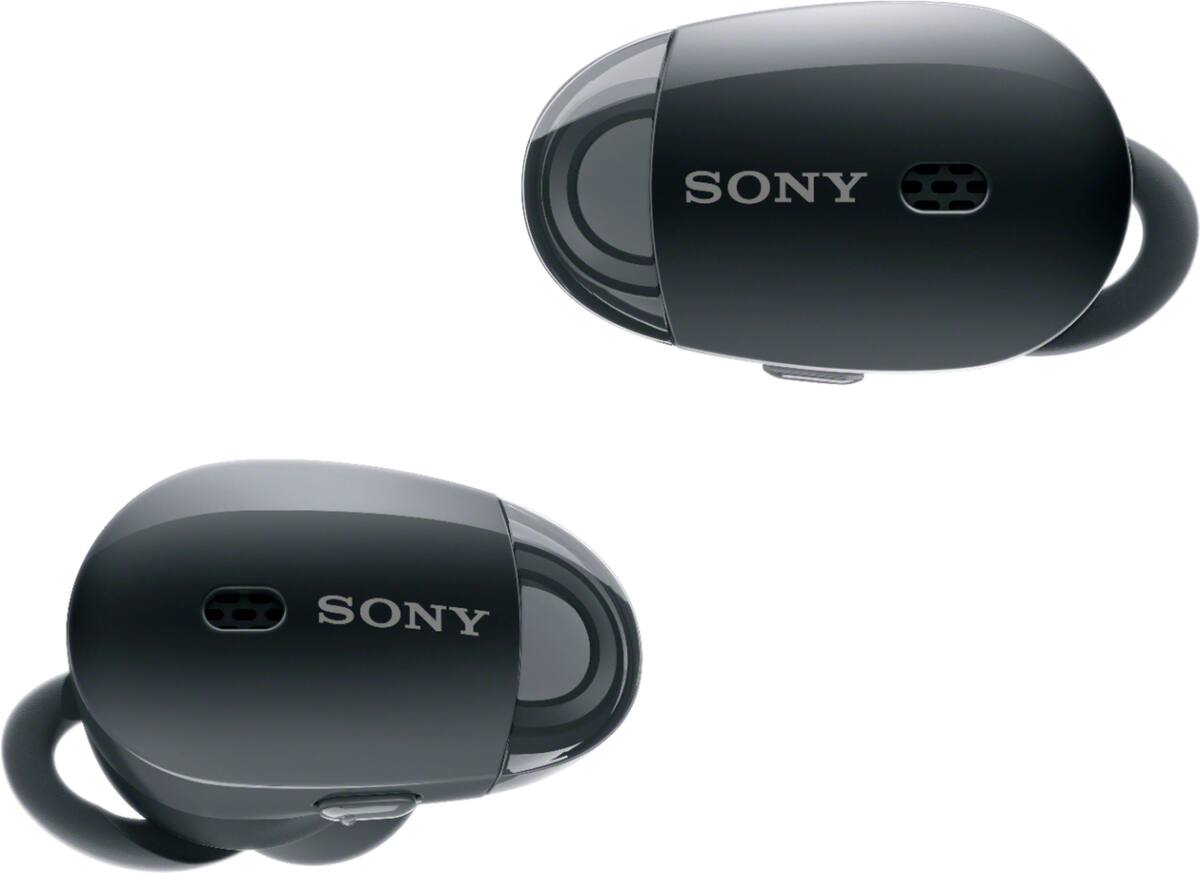
Sony's U.S. support page warns that included components may vary by country or region. The model manual describes the original accessories, while Best Buy identifies one U.S. retail configuration as WF1000X/BM1 and now labels item 6115440 unavailable in new condition. That gives a specific edition to search for, not evidence that a used offer contains its original tips, cable or documents. The Black product image here is the exact item listing's earbud image; it does not show the case or prove a seller's package is complete.
Age changes the practical question: Sony's launch figure cannot establish a used battery's present capacity. Ask the seller to confirm both sides pair, the case and micro-USB port work, and the model markings are correct. Check tip and supporter condition, return terms and any warranty. Support pages provide manuals, not a current offer or promise of parts.
Who should keep WF-1000X in view?
Keep WF-1000X in view only if an earlier model and short ANC session make comparison useful. It has a sealed-tip design, ANC/ambient modes and SBC/AAC support, but only two SBC or three AAC ANC hours per charge, micro-USB, no documented multipoint, and no established water or wireless-case rating.
It is not a substitute for the later WF-1000XM3; family naming proves no cross-generation tip, case or firmware compatibility. For a two-hour SBC ANC threshold, see the exact earlier sealed ANC matches in the finder. Confirm host codec support and the exact resale item. No listening, ownership, fit or battery test, customer experience, current price or stock is claimed.
Primary references: Sony USA's WF-1000X specification and support page; the model-specific WF-1000X Help Guide and its operating-time table; Sony's Headphones Connect compatibility list; the 2017 Sony Electronics U.S. announcement; and the exact Best Buy U.S. listing. Manufacturer claims are not independent performance results.
Key specifications
Key details at a glance
| Wearing style | Sealed in-ear |
|---|---|
| Active noise cancellation | Yes |
| Bluetooth version | 4.1 |
| Supported codecs (mode matters) | sbc / aac |
| Two-device Bluetooth multipoint | No |
Use the exact model’s instructions for operating limits, supplied equipment and version differences.
Sources for this review
Sources for this assessment
- Support for WF-1000X | Sony USA
- WF-1000X Specifications | Sony USA
- Sony Electronics Adds Three New Wireless Noise-Cancelling Headphones to the 1000X Family
- WF-1000X Help Guide | Sony
- Available operating time | WF-1000X Help Guide
- Supported codecs | WF-1000X Help Guide
- List of compatible devices | Sony Headphones Connect Help Guide
- Sony WF 1000X True Wireless In-Ear Noise Cancelling Headphones | Best Buy US
Compare the documented details with your routine
Use the finder to combine only requirements supported by one documented operating arrangement. It cannot guarantee comfort or compatibility with every host.