
Your needs, this model
Does it fit your priorities?
Does the IE 80S BT use a sealed in-ear fit?
Yes. Sennheiser's manual describes ear-canal coupling and gives silicone, lamellar-silicone and Comply foam tips in S/M/L; it instructs the wearer to check for a snug complete seal. That does not predict comfort or fit for an individual.
Explore this need in the finder →Can it remain connected to two source devices?
The exact-model manual says it automatically tries the last two connected Bluetooth devices when powered on and retains up to eight paired profiles. This documents a two-device connection arrangement, not two simultaneous audio streams or a particular source-switching experience.
Explore this need in the finder →Does the IE 80S BT support AAC from a compatible host?
Yes. The IE 80S BT manual lists AAC alongside SBC, aptX, aptX Low Latency, aptX HD and LHDC. Codec negotiation depends on the source device and software; only SBC has a published six-hour music maximum in the manual.
Explore this need in the finder →Is there active noise cancellation?
No ANC capability is documented for this model. The manufacturer describes passive attenuation from a well-fitted ear tip; that is not an ANC system, and the model manual supplies no ANC runtime.
Explore this need in the finder →What is the substantiated SBC listening-time claim for this neckband?
The manual specifies up to six hours of music playback via SBC on the built-in neckband battery. It does not supply a duration for the other listed codecs, and this source figure is not a test of a used unit's present battery.
Explore this need in the finder →This assessment covers Sennheiser's U.S. IE 80S BT, article 508240, a Bluetooth neckband system with sealed, tip-style earphones. Sennheiser now labels this product end of life and no longer sells it from its own U.S. page. This review uses manufacturer documentation and is not based on listening, fit trials, battery measurements or call testing. The condition, remaining battery capacity, warranty and availability of any individual used or new-old-stock offer are unknown.
Start with the form factor, not the codec list
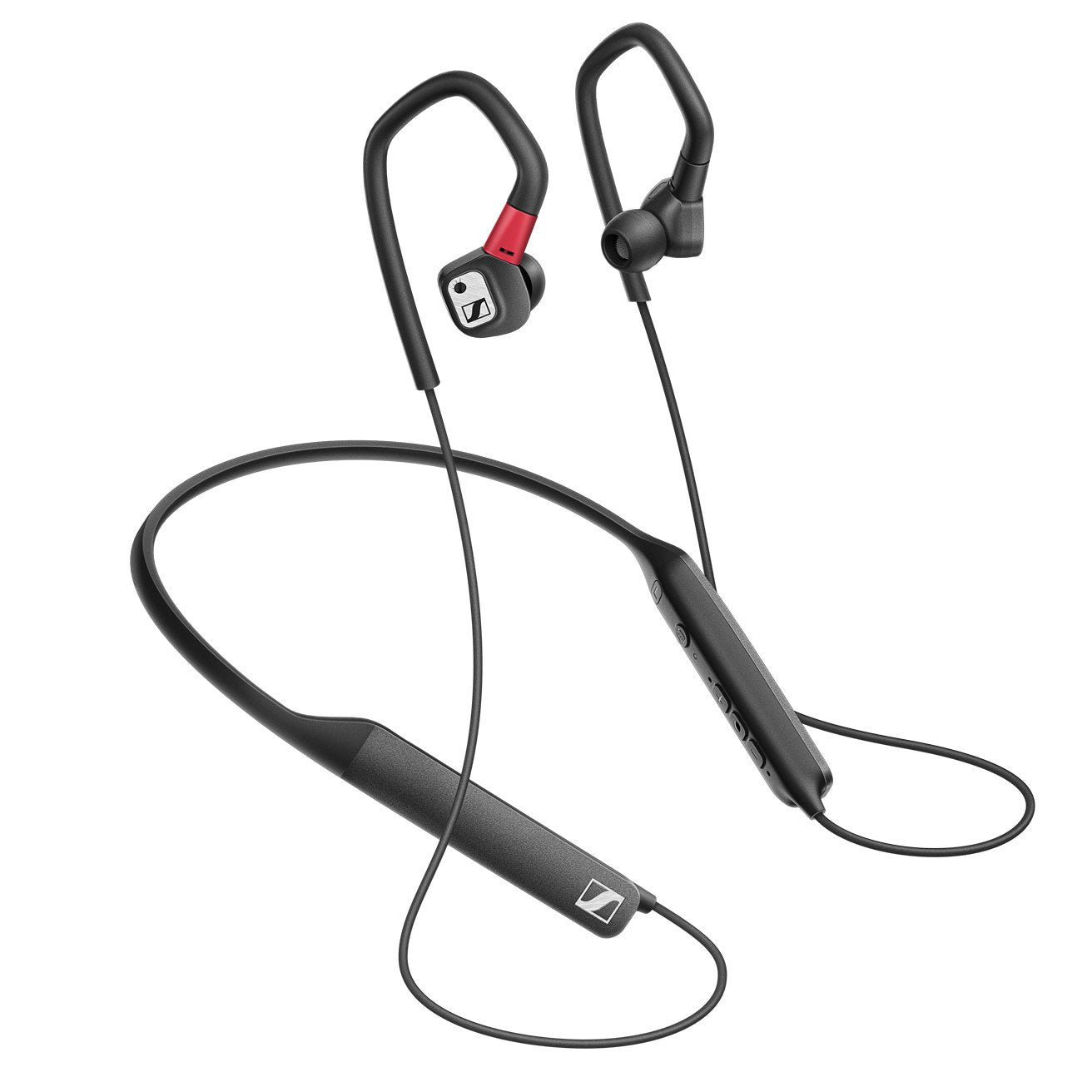
The IE 80S BT is not a pair of fully separate true-wireless buds. Its two earpieces connect through a removable Bluetooth neckband that rests around the neck. The earphones themselves can also detach from that neckband and connect to an optional wired RCs IE cable, but the parts list identifies that cable separately; do not assume it comes with the Bluetooth package. Sennheiser's parts page associates RCs IE with article 507489, separate from the IE 80S BT article 508240. If you want the earbuds to go into a charging case with no cable between them, this design is the wrong category of fit.
In the Bluetooth configuration, the neckband carries the battery and controls, and a USB-C socket charges that assembly. The included carry case is for storage rather than recharging, so there is no case-based extra listening reserve. The manual lists about 30 grams for the system. That is more information than the product photo alone provides, but it cannot tell you how a neckband will feel under a collar or during your particular routine. See Sennheiser's U.S. product record and the model manual specifications.
Fit offers several adjustments, but a seal is still personal
The manual describes ear-canal coupling and ear hooks that loop behind the ears. The package list names silicone, lamellar-silicone and Comply memory-foam adapters, each in sizes S, M and L. That is a wider set of supplied tip styles than a single material with several sizes, and it gives a purchaser a practical way to check different sealing surfaces. The manual still asks the wearer to try them: a snug seal affects sound and bass, but the documentation cannot guarantee that a particular ear shape will find a comfortable tip or tolerate an ear hook for a long session.
There is also a manual bass adjustment on the earpieces, plus a five-band equalizer in the Smart Control app. These are two distinct controls: the physical adjustment is a quick hardware change; the app exposes finer tonal settings and firmware functions. The manufacturer claims a balanced tuning, but neither that wording nor the presence of controls is an independent sound-quality finding. If you are comparing the simpler CX 150BT neckband review, note that these are different model generations and packages; compare their exact controls, codec lists and condition rather than treating the shared neckband shape as equivalent.
A broad codec list depends on the playback device
The IE 80S BT manual lists SBC, AAC, aptX, aptX Low Latency, aptX HD and LHDC over Bluetooth. A longer supported-codec list only matters when the phone, computer, operating system and chosen app support and negotiate the same codec. The Sennheiser manual says the headset uses a listed high-quality route when the source supports it and falls back to SBC otherwise. That does not promise that a service or device will deliver a better-sounding file, and it does not establish which mode you will actually use without checking your host settings.
The runtime boundary is especially important: the manufacturer specifies six hours of music playback via SBC from the neckband battery. The manual does not give matching runtime figures for AAC, aptX, aptX HD, aptX Low Latency or LHDC. Its six-hour value is not a universal figure for every codec, volume or aged battery, and it is not an ANC runtime. The built-in battery is specified as 120 mAh; a full charging cycle is about 1.5 hours, via USB-C. The charging instructions call for a compatible USB power supply ordered separately. No lab measurement was made for this review.
Two-device reconnection is useful, but not two audio streams
Sennheiser's manual says the headset automatically tries to connect to the last two Bluetooth devices when powered on and can remember profiles for up to eight paired devices. Those are different limits: two is the documented reconnect arrangement, while eight is the stored pairing list. This supports a two-host connection requirement, but it does not establish that audio plays from two sources simultaneously. The manual's codec and multipoint details should be considered alongside the source device rather than assumed to behave like modern multi-device app ecosystems.
The model includes a voice-assistant button, call controls and two omnidirectional MEMS microphones; the launch note also promotes noise-reduction microphone processing. These features establish a call and assistant use case, not measured intelligibility in traffic, wind or a busy room. Pairing begins through the Bluetooth menu on the host; Smart Control is needed for the full set of settings, including EQ and firmware updates. If you only want basic Bluetooth playback, distinguish the host pairing step from the app's optional adjustments.
No ANC or water rating is documented
The product sources describe passive noise attenuation from a sealed ear tip, not active noise cancellation. The manufacturer manual instructs users to keep the product dry and to clean it with a dry cloth. It provides no IP water-resistance rating or sweat-use promise. Do not turn a snug fit into an ANC claim, or a dry-care instruction into permission for exercise in rain. If cancellation or a stated moisture rating is essential, this model is not supported by the evidence reviewed here.
Older-unit checks matter more than the feature sheet
The exact U.S. product page marks article 508240 end of life. Sennheiser's support parts listing identifies the IE 80 S earphones and IEN BT neckband as system components and lists the wired RCs IE cable separately; it also says economical non-warranty repair service is unavailable. That is a reason to examine a seller's exact package, return terms and service coverage carefully, not a claim that every listing is unserviceable. A lithium battery in an older unit may have less capacity than the original six-hour specification, and the documentation does not tell us the state of any unit for sale.
The IE 80S BT makes sense to investigate only if you specifically want a sealed, adjustable neckband, value its documented codec range and can verify the host-device requirements. It is not the right shortcut to a charging-case or ANC feature set. Check the exact article 508240, included neckband and tips, whether an optional cable is actually included, the seller's battery/condition statements, warranty and return window before treating any offer as comparable.
Key specifications
Key details at a glance
| Wearing style | Sealed in-ear |
|---|---|
| Active noise cancellation | No |
| Wireless charging case | No |
| Bluetooth version | 5 |
| Supported codecs (mode matters) | sbc / aptx / aptx_ll / aptx_hd / aac / lhdc |
| Two-device Bluetooth multipoint | Yes |
| Maximum SBC music time | 6 hours |
Use the exact model’s instructions for operating limits, supplied equipment and version differences.
Sources for this review
Sources for this assessment
- IE 80S BT U.S. product page, article 508240 and end-of-life statement | Sennheiser
- IE 80S BT U.S. product record, single default variant article 508240 | Sennheiser
- IE 80S BT English instruction manual, version 06/19 A01 | Sennheiser
- IE 80S BT official manual specifications | Sennheiser
- IE 80S BT official manual getting-started and fit instructions | Sennheiser
- IE 80S BT official manual ear-adapter instructions | Sennheiser
- IE 80S BT official manual listening and call instructions | Sennheiser
- The Wireless Audiophile Experience You've Been Waiting For, IE 80S BT launch note | Sennheiser Newsroom
- IE 80S BT article 508240 service and spare-parts identity | Sennheiser
- IE 80S BT article 508240 appearance image | Sennheiser U.S.

Compare the documented details with your routine
Use the finder to combine only requirements supported by one documented operating arrangement. It cannot guarantee comfort or compatibility with every host.