
Your needs, this model
Does it fit your priorities?
Can these Pixel Buds Pro stay connected to two devices?
Google documents Multipoint for two concurrent Bluetooth sources, including phones, tablets, laptops and TVs. It is off by default, so pair both sources and enable it in Pixel Buds settings. The feature switches the connection; it does not mix two streams, and another source’s media must be paused before its playback starts. No codec or ANC-on battery duration is specified for the two-source plan.
Explore this need in the finder →What ANC listening time does Google publish?
Google lists up to seven hours of music with ANC on from the earbuds per charge, or 20 hours including case recharges; with ANC off it lists 11 hours per charge and 31 with the case. These are approximate manufacturer figures under specified playback conditions, not results from a test in this assessment and not a prediction of the remaining capacity of a used 2022 set. The 7-hour claim is not assigned to a codec or the Multipoint plan.
Explore this need in the finder →Does the Pixel Buds Pro case charge wirelessly, and how much water protection does it have?
Google lists USB-C and Qi charging for the case; a Qi charger is not included in its package list. It rates the earbuds IPX4 and the case IPX2, not the exact “IPX4 buds only, case unrated” arrangement or IP57 on both parts. Dry the earbuds and case before charging after exposure, and do not treat either rating as waterproofing.
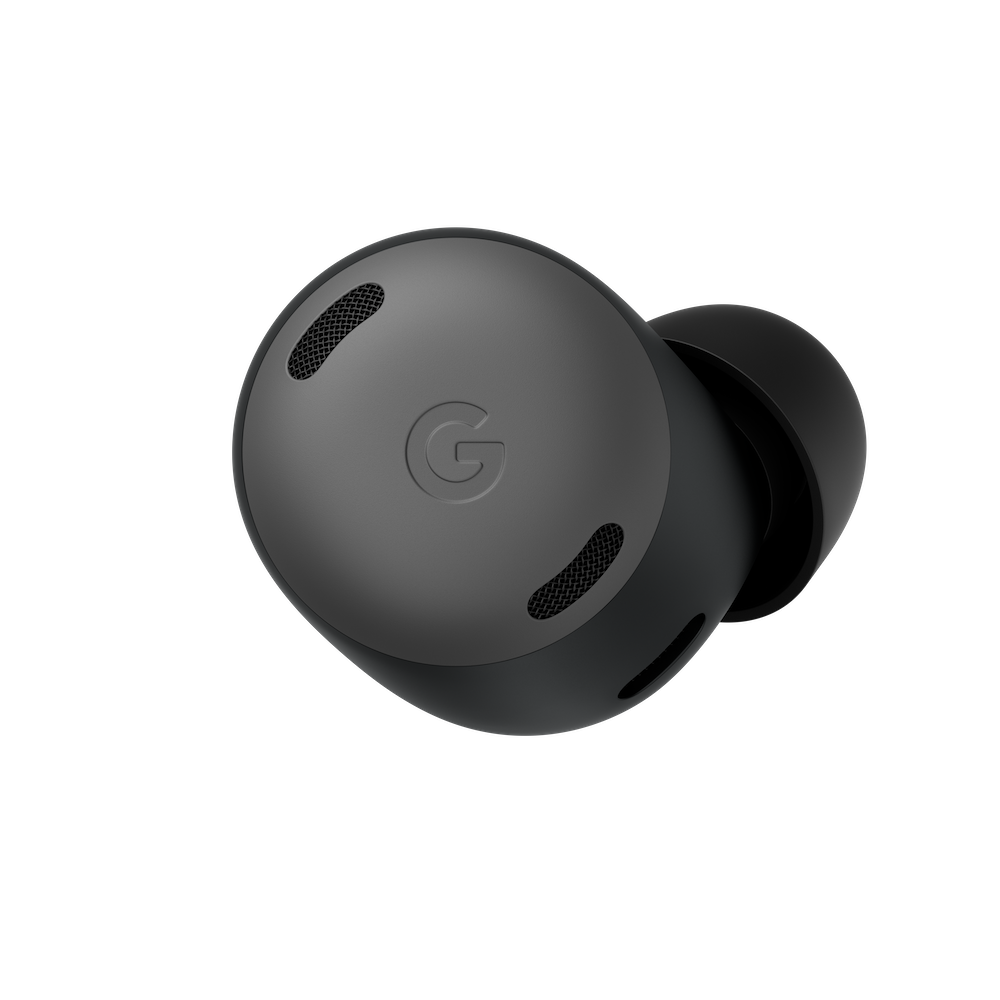
Explore this need in the finder →This is a source-based assessment of Google’s original Pixel Buds Pro, the 2022 sealed-tip model, in Charcoal. It is separate from Pixel Buds Pro 2 and Google’s lower-cost 2a. Google’s U.S. launch placed the model in its 2022 lineup; the current Store category shows the later Pro 2 and 2a families. That makes this an earlier-generation choice for the finder, not proof that a complete set is available today. This review interprets Google’s own specifications and help material; it is not a hands-on test.
Sealed tips and selectable noise modes
The Pro is an in-ear model with removable S, M and L tips, with M already attached. Google lists a seal check and active pressure-relief feature, along with Active Noise Cancellation, Transparency and Off modes. Those are useful fit tools and control options, but they cannot predict how an individual’s ears respond. If you dislike a canal tip, this is not an open-ear substitute; if the seal is poor for you, advertised ANC features do not repair that physical mismatch.
Google’s current settings matrix also lists Conversation Detection and Spatial Audio for the original Pro. Conversation Detection can move from ANC to Transparency when enabled, but those software-dependent features should be checked on the actual host and app version. Do not transfer Pro 2 capabilities such as Adaptive Audio, LE Audio, or its newer fit design to this 2022 model.
Seven ANC hours is a published maximum, not a test result
Google lists up to seven hours of music playback per earbud charge with ANC on and 11 hours with ANC off. Using case recharges, the table gives 20 ANC-on and 31 ANC-off combined hours. The case total is accumulated listening across multiple charges, not one uninterrupted session. Google’s note describes approximate figures from music playback on fully charged pre-production hardware and software, with other features disabled; active features and real use can reduce the result. This assessment did not measure runtime.
The seven-hour number is a broad product claim only. Google does not tie it to a named Bluetooth codec or to two-device Multipoint use. The numeric finder can include the model up to a seven-hour minimum, but it should not be read as a seven-hour promise under every mode. Most importantly for a pre-owned 2022 pair, a launch-era maximum says nothing about the surviving capacity of that unit’s batteries.
Multipoint is practical, with a clear limit
Google documents two simultaneously connected Bluetooth sources, such as a phone and laptop, but Multipoint is off by default and must be enabled after pairing. It helps move between devices; it does not combine their audio. Google says a call can take priority, while music on the other device must be paused before media starts from a second source. Neither the codec nor ANC-on listening time for this two-device arrangement is specified. Basic Bluetooth pairing is broader than the Google companion features; confirm the current host, Android/app requirements and account setup before counting on controls or automatic switching.
Qi and USB-C, but check the water-rating split
The charging case supports both USB-C cable charging and Qi-certified wireless charging. The listed package has the earbuds, case, three tip sizes and quick-start/safety material; Google does not list a Qi pad or charging cable in that package table. Verify the exact case in any used listing rather than assuming the box is complete or the charging contacts are healthy.
Google assigns IPX4 to the earbuds and IPX2 to the case. The case is therefore rated, not unrated, so the pair does not meet the finder’s exact “IPX4 buds only” option; it also is not IP57 on both parts. Neither rating means waterproof. Google advises drying the earbuds and case before charging after liquid exposure and warns that resistance can decline with wear or damage.
Where the original Pro sits now
The original model keeps useful essentials—ANC, Transparency, touch controls, Multipoint and a Qi case—while its Google support specifications list Bluetooth 5.0 and no LE Audio. The later Pro 2 is a different product: it updates the design and support matrix, including LE Audio, a fourth tip size and different battery figures. A color match or the word “Pro” does not make the cases, features or parts interchangeable. This library keeps the first Pro’s six documented colors—Charcoal, Fog, Lemongrass, Coral, Bay and Porcelain—as finish-only variants of one functional review. Google’s sources do not reveal separate complete-unit SKUs for each finish.
Who should investigate it
It is worth comparing only if an earlier sealed ANC set, a two-device Bluetooth mode and Qi charging are all useful to you. It is a weaker fit if you require open wearing, a confirmed Classic codec, LE Audio/LC3, a specific ANC runtime with Multipoint, or an exact water-rated package. Check that the seller is offering the original Pixel Buds Pro rather than Pro 2 or replacement earbuds, that the case and both buds belong together, that the desired finish and tips are present, and that battery condition, returns and warranty are explicit. No current offer, price, stock or unit condition is established here.
Primary sources: Google’s July 2022 U.S. launch announcement, 2022 feature and color announcement, 2023 color and software update, Pixel Buds technical specifications, charging and battery guidance, feature settings matrix, Multipoint instructions and cleaning and water-care guidance. Sources checked October 31, 2026.
Key specifications
Key details at a glance
| Wearing style | Sealed in-ear |
|---|---|
| Active noise cancellation | Yes |
| Wireless charging case | Yes |
| Water protection | Ipx4 buds ipx2 case |
| Bluetooth version | 5 |
| Two-device Bluetooth multipoint | Yes |
| Published ANC runtime per charge | 7 hours |
Use the exact model’s instructions for operating limits, supplied equipment and version differences.
Sources for this review
Sources for this assessment
- Pre-order your Pixel Buds Pro and Pixel 6a today | Google The Keyword
- 100 things we announced at I/O | Google The Keyword
- Google Pixel Buds Pro: More helpful features, refreshed colors | Google The Keyword
- Google Pixel Buds Requirements & Specifications | Google Pixel Buds Help
- Charging Google Pixel Buds | Google Pixel Buds Help
- Change your Google Pixel Buds settings | Google Pixel Buds Help
- Use Multipoint and audio switch on Google Pixel Buds 2a and Pro | Google Pixel Buds Help
- Clean your Google Pixel Buds | Google Pixel Buds Help
- Wireless earbuds with hands-free help from Google | Google Store US
Compare the documented details with your routine
Use the finder to combine only requirements supported by one documented operating arrangement. It cannot guarantee comfort or compatibility with every host.