
Your needs, this model
Does it fit your priorities?
Does the vent make this an open-ear earbud?
No. Google describes a silicone eartip that gently seals the ear plus a spatial vent that admits some environmental sound; the model is classed as sealed in-ear, not open-ear. That source description cannot predict whether the tip fits your ears.
Explore this need in the finder →Is the environmental sound feature the same as active noise cancellation?
No. Google's specification describes passive noise reduction and a spatial vent; it does not list ANC. The finder treats this model as a no-ANC earlier option, not an ANC substitute.
Explore this need in the finder →Can the case charge without plugging in a cable?
Google lists a Qi-certified wireless case and a USB-C port. A Qi charger is sold separately, and an older listing still needs the matching complete case.
Explore this need in the finder →Does this satisfy IPX4 on earbuds with an unrated case?
No exact match is assigned. Google's model-family care table says IPX4 buds and an IPX2 case, while its separate safety guide says IPX4 for both. The case scope conflicts, so the case field remains unknown and neither exact-water option is claimed.
Explore this need in the finder →Earlier model · U.S. launch record · source-based assessment
What this model is—and what the name can hide
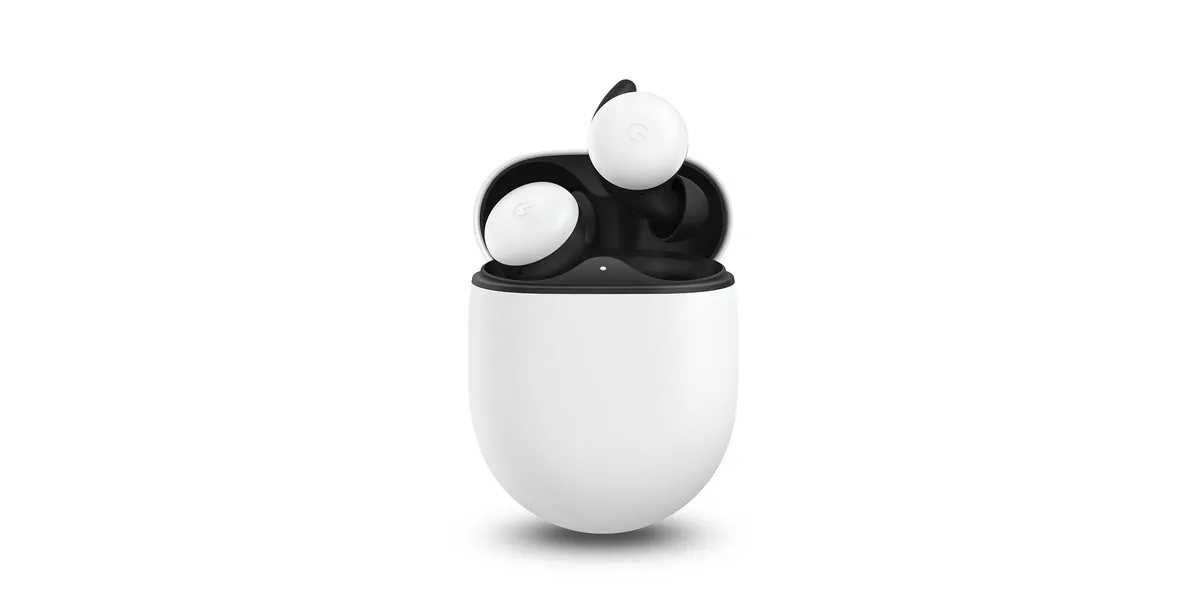
Google introduced a redesigned Pixel Buds in October 2019 for U.S. availability the following year; its April 2020 release note says the Clearly White version was then available in the United States. This is the independent-earbud, tip-sealed generation, not the original 2017 pair whose earpieces share a fabric cord. The official support article now calls the newer device “Google Pixel Buds” and refers to its charging case as the Pixel Buds (2020) case, so the year is included here to keep those generations distinct. The checked records do not establish a finish-specific full-product SKU, current sale status, or the condition of any present-day listing. Google’s 2019 introduction · 2020 U.S. availability note.
A sealed tip with a vent is still a sealed fit
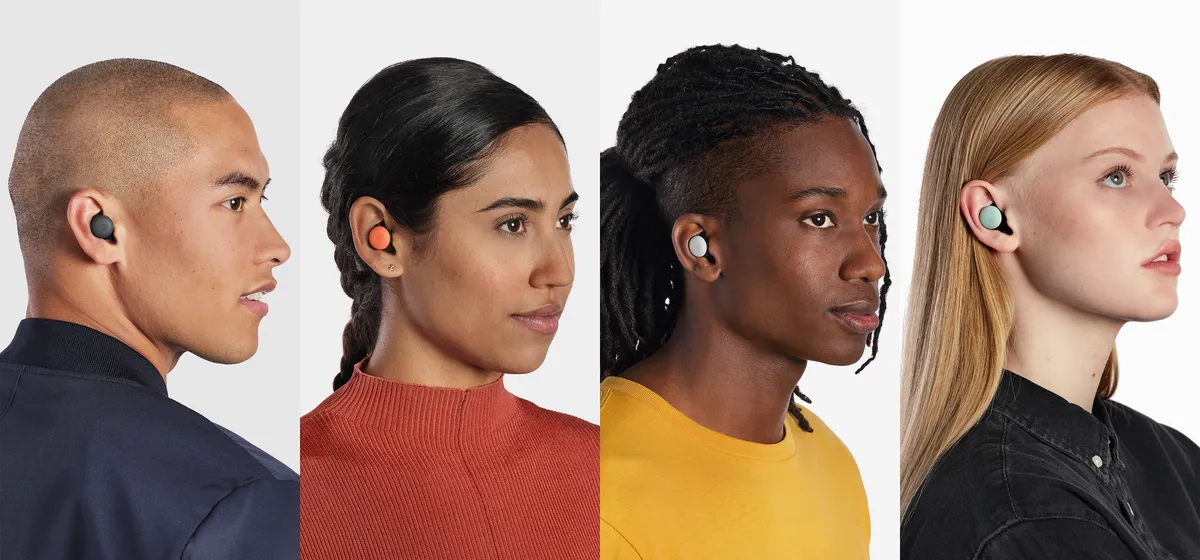
Google describes an interchangeable ear tip that gently seals the ear and a spatial vent that admits some ambient sound while easing the plugged-ear feeling. The support package lists three tip sizes, with medium attached. That combination is best read as sealed in-ear—not open-ear—even though the vent is intended to preserve some awareness of the surroundings. Tip size and shape still have to work for the individual; the documentation cannot predict seal quality, long-wear comfort, or whether movement loosens a bud. No fit trial was performed for this assessment. Google's design description · Google's current specification and package table.
Do not mistake ambient sound or Adaptive Sound for ANC
The 2020 specification lists passive noise reduction, a vent, and a 12 mm dynamic driver; it does not list active noise cancellation. Google’s launch material explains that the vent lets some environmental sound through, while Adaptive Sound makes subtle volume adjustments as the environment changes. Neither feature is the same as electronic ANC, and neither supports a claim that the buds erase traffic or speech. This assessment classifies the model as no-ANC from its documented feature set, not from a cancellation test. The separate finder choice for older models matters: this design does not belong in an ANC shortlist just because it seals with a tip. Model specifications · 2019 feature description · Adaptive Sound description.
Bluetooth basics, with important gaps left as gaps
Google lists Bluetooth 5.0 for the earbuds and compatibility with Bluetooth 4.0-or-newer Android and iOS devices, tablets, and laptops. Fast Pair and Google Assistant are useful parts of the documented experience, but broader Assistant and Translate functions have additional Android, Google-account, app and internet requirements. Those are host-side dependencies, not evidence of a guaranteed current service path for an older set. Google's reviewed product table does not name SBC, AAC, LDAC, or LC3; it also does not establish LE Audio or two simultaneous connected source devices. We leave those details unknown instead of guessing from Bluetooth version, the Google brand, or a separate-generation feature. Verify the exact host and application support before buying if a codec or device-switching capability is essential.
Qi and USB-C coexist; battery figures are not a used-unit promise
The supplied case is documented as supporting Qi wireless charging and USB-C cable charging. A Qi charger is sold separately, so the wireless option does not mean the necessary charging pad is in the box. Google's listed package is earbuds, wireless charging case, three tip sizes, USB-C-to-USB-A cable, and Quick Start Guide; a used offer still needs the matching case and complete components. The support specification gives manufacturer maxima of up to five hours of listening per charge and up to 24 hours with case recharges, plus up to two hours of listening from a ten-minute charge. Google does not provide an unambiguous 2020-specific test basis in the checked material: the footnote adjacent to its current technical table is explicitly for Pixel Buds Pro, so those test conditions are not carried over. These are manufacturer claims, not measurements here, not a codec-specific result, and not an estimate of capacity remaining in an older battery. Because the model has no ANC, its general listening number is not ANC-on time. Specifications and box contents · Charging help.
Water protection is not a clean match to either finder option
Google's model-family care page distinguishes the 2020-era Pixel Buds from the A-Series and later Pro products. Its footnote assigns IPX4 to the earbuds and IPX2 to the original Pixel Buds case. A separate official safety guide instead calls both the Pixel Buds and case IPX4. Because these Google sources conflict about the case, this assessment leaves the exact case-water field unresolved; it does not present the product as “IPX4 buds only, case not rated,” nor as IP57 buds and case. Both sources warn that the product is not waterproof and that resistance can decline with wear, repair or damage. Do not submerge it or charge a wet case, and treat an older listing's condition as a separate risk. Model-family water-care page · Google safety guide.
Who should consider it—and what to check first
This is a narrow fit for someone who specifically wants an earlier, sealed-tip Google design without ANC and values the flexibility of both Qi and USB-C charging. It is a poor match for a must-have ANC requirement, a known codec or Multipoint requirement, or either exact water arrangement in the finder. The A-Series is a separate later model with a USB-C-only case and an earbuds-only IPX4 classification; newer 2a and Pro models add features that should not be transferred back to this 2020 version. Compare their individual assessments rather than using “Pixel Buds” as a family-wide specification. Pixel Buds A-Series assessment · Pixel Buds 2a assessment.
For any older offer, confirm that it is the 2020 generation, not Gen 1 or a later replacement; check the actual finish and included case, tips and USB cable; and confirm the seller's condition, return window and warranty. Ask for a current charging demonstration if the unit is used: a historical manufacturer maximum cannot tell you its present battery health. This review is based on Google's public launch, support and safety materials. No earbuds were owned or tested for listening, comfort, calls, connectivity, water resistance, or battery endurance.
Key specifications
Key details at a glance
| Wearing style | Sealed in-ear |
|---|---|
| Active noise cancellation | No |
| Wireless charging case | Yes |
| Bluetooth version | 5 |
Use the exact model’s instructions for operating limits, supplied equipment and version differences.
Sources for this review
Sources for this assessment
- Meet the new Google Pixel Buds | Google The Keyword
- The new Google Pixel Buds are available today for your listening pleasure | Google The Keyword
- Boost your bass and share your sounds, with Pixel Buds | Google The Keyword
- Inside the Google team that dreams up colors | Google The Keyword
- Google Pixel Buds requirements and specifications | Google Pixel Buds Help
- Clean your Google Pixel Buds | Google Pixel Buds Help
- Safety, Warranty & Regulatory Guide (Pixel Buds) | Google product documentation
- Charge your Google Pixel Buds & charging case | Google Pixel Buds Help
Compare the documented details with your routine
Use the finder to combine only requirements supported by one documented operating arrangement. It cannot guarantee comfort or compatibility with every host.