
Your needs, this model
Does it fit your priorities?
How is the heart-rate feature different from a regular SoundSport Wireless?
Bose's model-specific manual identifies an optical heart-rate sensor in the left Pulse earbud and a matching replica on the right. It can show a heart-rate value in Bose Connect or a compatible fitness app; the left bud must fit securely throughout the workout. Some fitness apps may require a subscription. This is a feature distinction, not a tested accuracy claim.
Explore this need in the finder →Can it stay connected to two devices at once?
Yes. Bose's guide says up to eight devices may be stored and two can be actively connected, while audio can play from only one at a time. That lets the listener switch sources without losing both pairings; it does not mix two audio streams.
Explore this need in the finder →Does its carry case charge the earbuds?
No charging case is listed in the Pulse package. The supplied USB cable plugs directly into the connector under the right earbud; the separate carry case is for storage. Bose does not identify that input as USB-C.
Explore this need in the finder →Can I choose IPX4 or IP57 for the Pulse?
The reviewed Bose sources do not provide an IP rating for this exact configuration. A general sweat- and water-resistant description is not enough to satisfy either of the finder's exact IPX4 earbuds-only or IP57 buds-and-case choices.
Explore this need in the finder →Can it meet a minimum ANC-hours requirement?
No ANC mode is documented in the reviewed model-specific feature and control inventory, so this assessment classifies it as no-ANC by inference. Bose's up-to-five-hour claim is ordinary per-charge playback, not ANC-on time, and cannot meet a numeric ANC minimum.
Explore this need in the finder →This assessment covers the earlier Bose SoundSport Pulse wireless headphones in the Power Red U.S. configuration, part 762518-0010. It is a Bluetooth sport earbud with a cable between its earpieces, an inline remote and a left-ear heart-rate sensor. It is functionally distinct from the standard SoundSport Wireless and from Bose's later SoundSport Free true-wireless earbuds. The points below come from Bose's U.S. launch and catalog, the Pulse owner's guide and Bose support; no workout, heart-rate accuracy, fit, sound, call or battery test was conducted.
The pulse sensor is the defining difference
Bose places the heart-rate sensor in the left earbud and a matching sensor-shaped component on the right. The guide explains that readings can appear in Bose Connect or a compatible fitness app after setup. It is more specific than simply calling the Pulse a red SoundSport: the sensor and its software workflow are a model feature that the standard SoundSport Wireless does not have in its reviewed guide.
The left earbud must fit securely throughout a workout for the documented sensor workflow. Bose's manual asks the wearer to select the right StayHear+ Pulse tip size, keep its sensor aligned through the matching opening and maintain a secure left-ear fit. Depending on the fitness app, the user may need to choose “HR-Bose SoundSport Pulse” as the sensor or start a workout before the reading appears. Bose also says some apps require a paid subscription for detailed heart-rate data. Those setup requirements matter more than a broad marketing claim: I am not treating the product's promotional accuracy wording as an independent measurement or medical result.
A sealed tip and under-ridge wing
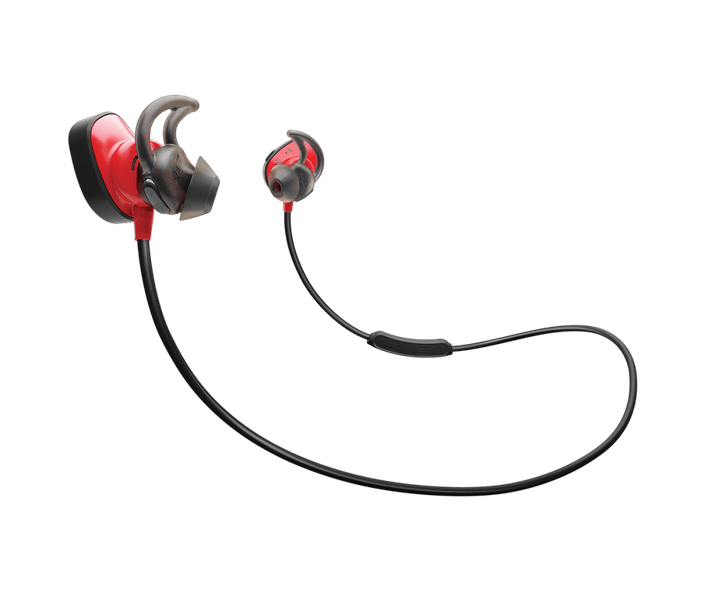
The Pulse uses Bose's StayHear+ Pulse tips at the canal opening, with a flexible wing beneath the ear ridge. Bose supplies small, medium and large sizes and warns that each side may need a different size. That classifies it as sealed in-ear, not open-ear. The wing and cable make the physical layout identifiable in a product photograph, but they do not establish how comfortable or secure it will feel to you. For a used example, check that all three tip sizes are included, the left/right tips are not reversed and the sensor apertures are not blocked.
A wire links the two earpieces, and a removable clothing clip is in the guide's component diagram. The inline remote handles calls and playback; this is not a pair of fully independent earbuds. If a separate bud falling out would be a bigger concern than the cable, that construction may be worth comparing, but Bose's documentation cannot decide how any given person will prefer it.
Five hours, charged at the earbud
The Pulse manual says a full charge takes up to two hours and powers the headphones for up to five hours. The USB cable plugs into the right earbud. A carry case is listed in the package, but no charging case is listed. In other words, the extra feature is heart-rate sensing, not extra case capacity. Bose's U.S. Fall 2017 catalog distinguishes the Power Red Pulse as part 762518-0010 from the standard SoundSport Wireless colors and their separate part numbers.
That five-hour figure is a manufacturer maximum for its original product, not an estimate for an older battery. Bose's Canada-labeled support result records a 2016–2020 sold-from range; it is a model-family lifecycle signal, not a U.S.-specific sales interval. The U.S. launch and U.S. catalog verify the American configuration, but neither one establishes an offer today. If you are evaluating a secondhand listing, ask for the model label, verify both sides charge, inspect the right-earbud USB input, test that the sensor is recognized in your intended app, and confirm the return terms. Present battery life depends on the actual unit.
Bluetooth switching is useful but limited
The Pulse guide says it can store up to eight paired devices and stay actively connected to two, but only one can play audio at a time. A phone and another source can remain linked while you switch playback; audio from both does not play together. Bose names Bluetooth and NFC pairing but not a Bluetooth version or a supported audio codec, so check the source device separately if codec compatibility is essential.
The reviewed launch material describes the Pulse heart-rate function, sport fit, inline control and app rather than ANC. Its full model-specific guide does not list an ANC mode or cancellation control. I therefore classify it as no-ANC by feature-inventory inference, not a direct quoted Bose declaration. The up-to-five-hour playback figure is not ANC-mode runtime. Bose's sport release uses a broad sweat- and water-resistant phrase for the SoundSport sport headphones, but this review set contains no IP code or exact component boundary for the Pulse. That wording does not satisfy a strict IPX4 earbuds-only or IP57 buds-and-case requirement.
When the Pulse is worth comparing
Consider this model only if the heart-rate sensor is a feature you actually plan to configure in a compatible app and you accept a cable-connected, sealed sport-earbud shape. The feature has setup and fit conditions, and some app data may sit behind a subscription. If you only want Bose's older wired sport fit and do not need the sensor, the standard SoundSport Wireless is a different product with its own six-hour maximum and separate catalog numbers. Neither model should be confused with the sealed SoundSport Free true-wireless design.
The exact Power Red image below is an appearance reference from Bose's own 2016 press materials. It does not verify what a seller includes, a used unit's sensor condition, the battery state or present availability.
Primary references: Bose's 2016 U.S. launch announcement, Bose U.S. Fall 2017 catalog, the SoundSport Pulse Owner's Guide, and Bose Canada Support's lifecycle/software page.
Power Red appearance reference
Key specifications
Key details at a glance
| Wearing style | Sealed in-ear |
|---|---|
| Active noise cancellation | No |
| Two-device Bluetooth multipoint | Yes |
Use the exact model’s instructions for operating limits, supplied equipment and version differences.
Sources for this review
Sources for this assessment
- Bose Introduces Wireless QC Noise Cancelling Headphones and Wireless Sport Headphones
- Bose U.S. Premiums and Incentives Catalog, Fall 2017
- SoundSport Pulse wireless headphones Owner's Guide
- SoundSport Pulse software and firmware versions — Bose Canada Support
- Bose 2016 pressroom SoundSport Pulse Power Red product image

Compare the documented details with your routine
Use the finder to combine only requirements supported by one documented operating arrangement. It cannot guarantee comfort or compatibility with every host.