
Your needs, this model
Does it fit your priorities?
Can the QuietControl 30 turn active noise cancellation off?
Bose's launch announcement says the QC30 adjusts noise cancellation, not on or off. Its model-specific guide describes twelve levels: level 1 is least cancellation/full awareness and level 12 is strongest. The headphones start at level 12. Level 1 is a less-cancelled listening mode, not a documented electronic-off mode.
Explore this need in the finder →Do Bose's 10 hours qualify for a numeric ANC requirement?
No. Bose states up to 10 hours from a full charge, but the source does not tie the number to a particular ANC level, codec or test condition. Active cancellation is documented; ANC-mode listening time is not. This record therefore does not match even a one-hour ANC minimum on the strength of the general headline.
Explore this need in the finder →Can I stay connected to two devices?
Yes. The Owner's Guide says the QC30 can store up to eight paired devices and remain actively connected to two, but only one device can play audio at a time. This is two-device connection switching, not concurrent playback.
Explore this need in the finder →Does the case use USB-C or wireless charging?
The carton contains a carry case and a USB cable, not a charging case. The USB connector is on the inside of the right neckband. Bose does not identify it as USB-C, and there is no documented charging case for a wireless-charging requirement.
Explore this need in the finder →What fit and water information is documented?
Bose's guide describes a StayHear+ QC sealed in-ear tip with a wing below the ear ridge and recommends trying all three sizes. The reviewed model documents no IP code or water-protection claim, so it does not meet the finder's IPX4 or IP57 choices. Fit and moisture handling need their own checks.
Explore this need in the finder →This is a source-based assessment of the earlier Bose QuietControl 30 wireless headphones in Black, U.S. part 761448-0010. The QC30 is a Bluetooth in-ear earphone with both earpieces attached to a neckband-style battery/control band; it is not a pair of true-wireless earbuds. Bose describes it as an adjustable noise-cancellation model, while its U.S. product catalog and support page identify the Black model and earlier sold-from window. No hands-on fit, cancellation, sound, call, battery or street-safety test was performed.
Twelve levels, not an ANC on/off switch
The feature that distinguishes the QC30 is a set of twelve noise-cancellation levels. Bose defines level 1 as the least cancellation, or full awareness, and level 12 as the strongest cancellation; the headphones start at level 12 when powered on. You can change the amount with buttons on the inline remote or through the Bose Connect app. The 2016 Bose release explicitly contrasts this control with a simple on/off function: it lets the wearer increase or reduce cancellation rather than switch the system off.
That distinction is easy to miss in a short listing headline. “Awareness” here is the least-cancelled setting of a tip-sealed ANC headphone, not an open-ear physical design. The model still uses soft StayHear+ QC tips at the canal opening. Bose's safety guidance warns against using noise-cancelling mode where missing an outside warning could be dangerous, and cautions that familiar sounds may change even in its awareness setting. Do not treat level 1 as a substitute for situational awareness in traffic or another hazardous setting.
Fit is a canal tip plus an around-neck band
The owner's guide says to rest the StayHear+ QC tip at the canal opening and tuck its wing beneath the ear ridge. It includes small, medium and large sizes, with medium fitted, and notes that the two ears may require different sizes. That is a sealed in-ear fit, but the shape is only a fit description. Bose recommends trying sizes rather than assuming the stock medium will work. A poor seal may change the wearer's experience of cancellation; the manufacturer instructions are not a personal fit result.
The cable and band connect the pair of buds to electronics and controls around the neck. This older design differs from contemporary models with a charging case and independent left/right housings. It can be a deliberate layout choice if you prefer the battery and buttons off the earbud shell, but the band remains part of the thing you wear. The included case is for storage, not a case that recharges the headphones.
The ten-hour maximum is not an ANC promise
Bose says to allow up to three hours for a full charge and lists up to ten hours of use from that full charge. The cable goes into a USB connector under the right side of the neckband. Although cancellation is enabled at its strongest level on startup, the reviewed guide and launch release do not tie the ten-hour figure to a named ANC mode, codec or test condition. This review therefore does not convert a general battery headline into “ten hours with ANC on.” A numeric ANC minimum is unsupported for the QC30.
The earlier maximum also says nothing about the battery condition of a used example. The official support page labels this model Sold from 2016–2020, and the U.S. catalog lists the Black configuration as 761448-0010. Neither the old catalog nor a lifecycle page is proof that a particular unit is available, genuine, complete or still capable of its original maximum. For a used listing, check that the USB port flap closes, the cable connects, the controls adjust cancellation, all three tip sizes and the storage case are present, and the seller offers a way to return the set if the battery or ANC buttons fail.
Two connected sources, one playing at a time
The manual allows up to eight devices in the pairing list and two active Bluetooth connections. It also says that only one device can play audio at a time. That is practical multipoint switching, not two simultaneous streams. Bose explains that the wearer pauses the first device before playing from the second. If switching is part of your everyday routine, verify that the exact host devices can pair and behave as expected; the old manual cannot certify a current laptop, operating system or app.
The model documentation does not name an audio codec or Bluetooth version. It also provides no IP rating or water-resistance claim. The QC30's inline buttons, app and ANC levels are model-specific facts, but they do not establish an IPX4 buds-only or IP57 buds-and-case arrangement. The box lists a carry case, USB cable and earbuds, not a rated or charging case.
Who should compare this earlier model?
The QC30 is relevant if you deliberately want Bose's older neckband earphone format with adjustable ANC, tip-based fit and documented two-device connection. Its useful evidence-backed points are the twelve-step control range, physical awareness-to-cancellation adjustment, fitted-tip guidance and official one-source-at-a-time multipoint instructions. Its limits are just as important: the product is not an open earbud, the 10-hour figure is not an ANC-runtime boundary, no exact codec or Bluetooth version is established, and the device charges at its own neckband connector rather than a charging case.
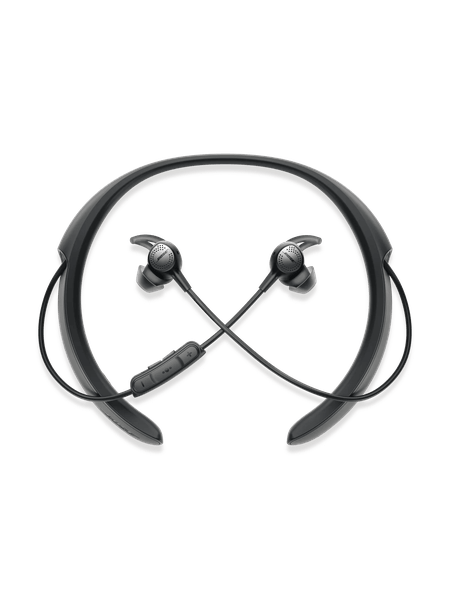
For each secondhand or old-stock offer, confirm the exact QuietControl 30 Black model and the actual condition rather than relying on a family-level title. Bose's listing does not establish present stock or seller quality. The official Black artwork below illustrates the product's shape only; it does not show the full box or verify a seller's particular unit.
Primary references: Bose's 2016 U.S. launch announcement, the Bose U.S. Fall 2017 catalog, the QuietControl 30 Owner's Guide and Bose QuietControl 30 Support.
QuietControl 30 Black appearance reference
Key specifications
Key details at a glance
| Wearing style | Sealed in-ear |
|---|---|
| Active noise cancellation | Yes |
| Two-device Bluetooth multipoint | Yes |
Use the exact model’s instructions for operating limits, supplied equipment and version differences.
Sources for this review
Sources for this assessment

Compare the documented details with your routine
Use the finder to combine only requirements supported by one documented operating arrangement. It cannot guarantee comfort or compatibility with every host.