
Your needs, this model
Does it fit your priorities?
Are Hearphones true-wireless buds, or is there a cable between them?
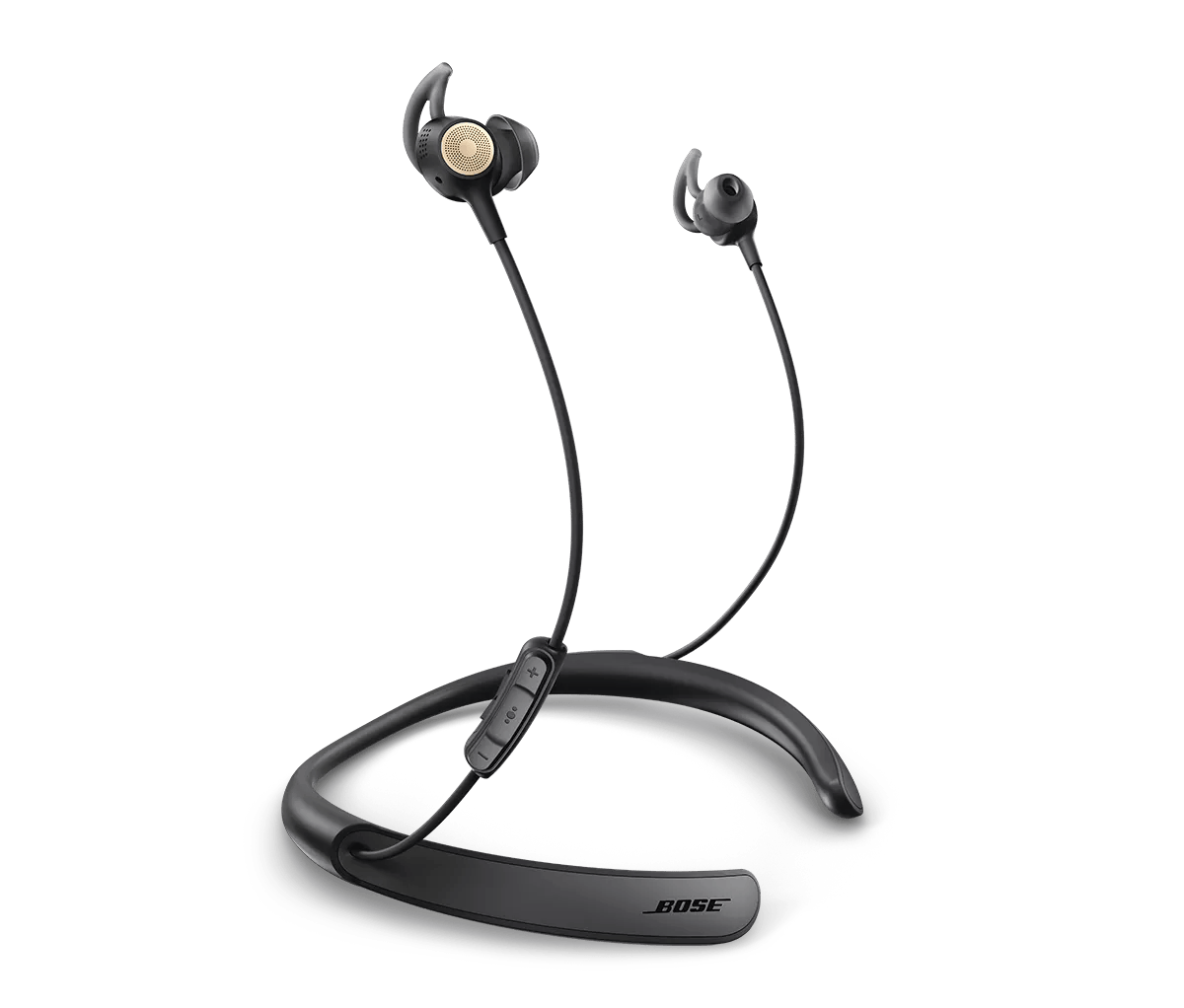
They are not true wireless. Bose's official product image and model guide show two in-ear buds connected by cables to a neckband. Bluetooth carries the source connection, but the cables and band remain part of the wearable arrangement.
Explore this need in the finder →Can I connect Hearphones to two devices at the same time?
Yes. Bose's Owner's Guide says the product can store up to eight paired mobile devices and can be actively connected to two at once. Only one device can play audio at a time, so this is source switching rather than simultaneous playback.
Explore this need in the finder →Does the advertised up-to-10-hour maximum satisfy an ANC-on runtime requirement?
No. Bose's manual gives up to 10 hours from a full charge but does not tie that general figure to music with World Volume noise cancellation, a particular codec or a named listening condition. The assessment therefore leaves ANC-on music hours unknown; it cannot meet even a one-hour ANC runtime threshold.
Explore this need in the finder →Does Bose classify Hearphones as a hearing aid?
No. Bose's Owner's Guide calls it a personal amplifier, not a hearing instrument or hearing aid, and says it is not intended to replace a properly fitted and calibrated hearing instrument. Do not treat the product as medical or hearing-care advice.
Explore this need in the finder →This is a source-based assessment of the earlier U.S. Bose Hearphones conversation-enhancing headphones, Black model 770341-0010. No listening, fit, battery or call tests were performed. Bose designed Hearphones around managing live environmental sound and following conversations, while also supporting Bluetooth music and calls. That makes them an unusual sealed in-ear option, not a replacement for an ordinary ANC earbud or a hearing aid.
A neckband for a different listening task
“Wireless” here means Bluetooth to the source device. Each earbud is still cabled to the control and battery neckband, so this is not a true-wireless pair. Bose's U.S. product catalog describes Hearphones as conversation-enhancing headphones and uses the term Active Noise Reduction. The Owner's Guide calls its World Volume function adjustable noise cancelling: it can make quieter environmental sounds more audible, reduce environmental sound, and steer attention toward Everywhere, Front or Focused directions. This lets the product serve an ambient-listening task that a quiet-first ANC earbud approaches differently.
The boundary matters. The manual describes processing live voices and other surroundings; it does not establish a conventional music ANC mode with a separate ANC-on playback specification. Bose also says the product is a personal amplifier, not a hearing instrument or hearing aid, and not intended to replace a properly fitted and calibrated hearing instrument. It should not be treated as medical advice or as a substitute for professional hearing care.
Fit is sealed-in-ear, but not true wireless
The supplied StayHear+ tips have a wing that tucks below the ear ridge. Bose instructs the wearer to let a tip rest at the canal opening and recommends trying all three sizes: medium is attached, while small and large are in the package. Bose notes that the left and right ears can need different sizes. This supports a sealed-in-ear design classification, but it cannot tell a particular buyer whether the tips will seal, stay comfortable or avoid feedback. Bose's guide says to reduce World Volume and check tip fit if the earbuds whistle.
The neckband and short cables are part of the wearing system, not an optional accessory. That may be preferable to a fully wireless bud for some routines, but it is a distinct fit and storage arrangement. The image below is the exact black Hearphones manufacturer rendering; it shows the product, not a complete seller's package.
Two connected sources, one playback stream
Bose documents Bluetooth pairing through the Hear app, the phone's Bluetooth settings or NFC. The Owner's Guide says the pairing list can store up to eight mobile devices and that two can be actively connected at once. Only one source can play audio at a time. In practical terms, the second connection is for switching between devices, not mixing two programs. A codec name and Bluetooth version are absent from the reviewed Bose material, so I do not infer SBC, AAC or a version from Bluetooth support alone.
The manual names the Bose Hear app for deeper conversation-enhancement settings, such as World Volume, left/right balance and frequency emphasis. It also provides direct Bluetooth-menu and NFC pairing routes. I could not establish from the reviewed current manufacturer pages whether the separate Hear app remains available and compatible with a particular modern phone; verify that before relying on its extra controls. Core pairing is not documented as app-only, but some conversation settings are.
Battery claim and charging are not a runtime test
Bose's Owner's Guide says a full charge powers Hearphones for up to 10 hours, takes up to three hours to charge, and that the headphones do not play while charging. The ten-hour number is a broad manufacturer maximum, not an ANC-on music figure tied to a codec or a disclosed use condition. It therefore cannot satisfy a request for a minimum number of ANC music hours. It also says nothing about the present capacity of a battery in a unit sold years ago.
The original package list includes a carry case, USB cable and three StayHear+ tip sizes; it does not list a charging case. The cable connects to a USB port on the right side of the neckband. Bose does not identify that connector as USB-C or Micro-USB in the source material reviewed here. Do not translate a generic USB reference into a current connector assumption.
How it compares with other earlier Bose neckband buds
Hearphones and QuietControl 30 share an older Bose neckband format, but the buying decision is not the same. The QC30 is documented with adjustable active noise cancellation and 12 cancellation levels. Hearphones instead centers conversation enhancement and World Volume/directivity, while Bose's documents do not establish its music-mode ANC runtime. SoundSport Wireless and SoundSport Pulse are exercise-focused cabled earbuds with two connected devices and one playback stream; they do not have this conversation-enhancement system. These distinctions are more useful than treating all three as interchangeable “Bose neckband” products.
What to verify on an older listing
Bose Support labels the product sold from 2017 to 2020. That is lifecycle context, not proof that a new or used unit is available now. Match the black U.S. model 770341-0010, then check the seller's actual condition, battery behavior, included USB cable, carry case and all three ear-tip sizes. Ask whether the Bose Hear app settings work on the intended phone; do not rely on a product photo to prove accessories. I found no IP water rating, no named audio codec and no ANC-on runtime in the reviewed Bose U.S. catalog and guide, so none should be assumed for travel, exercise, immersion or long listening sessions.
The strongest documented fit is a buyer who wants a sealed ear-tip design, accepts a neckband and cable, values adjustable live-sound/conversation control, and may switch one playback stream between two connected devices. The trade-off is an aging product with app-dependent advanced settings and incomplete modern compatibility details. This is an earlier product assessment, not a price, stock, battery-health or hands-on endorsement.
Primary references: Bose's Hearphones product support and lifecycle page, the U.S. catalog entry, and Bose's Owner's Guide.
Key specifications
Key details at a glance
| Wearing style | Sealed in-ear |
|---|---|
| Active noise cancellation | Yes |
| Two-device Bluetooth multipoint | Yes |
Use the exact model’s instructions for operating limits, supplied equipment and version differences.
Sources for this review
Sources for this assessment
Compare the documented details with your routine
Use the finder to combine only requirements supported by one documented operating arrangement. It cannot guarantee comfort or compatibility with every host.